Here are a few of my recent research projects:
Objective Observations in Everyday Settings
Applied research in early childhood is hindered by a lack of objective tools for observing children’s everyday behavior in the classroom. Teacher reports are subjective. Classroom observations are resource intensive. Direct assessments lack ecological validity.
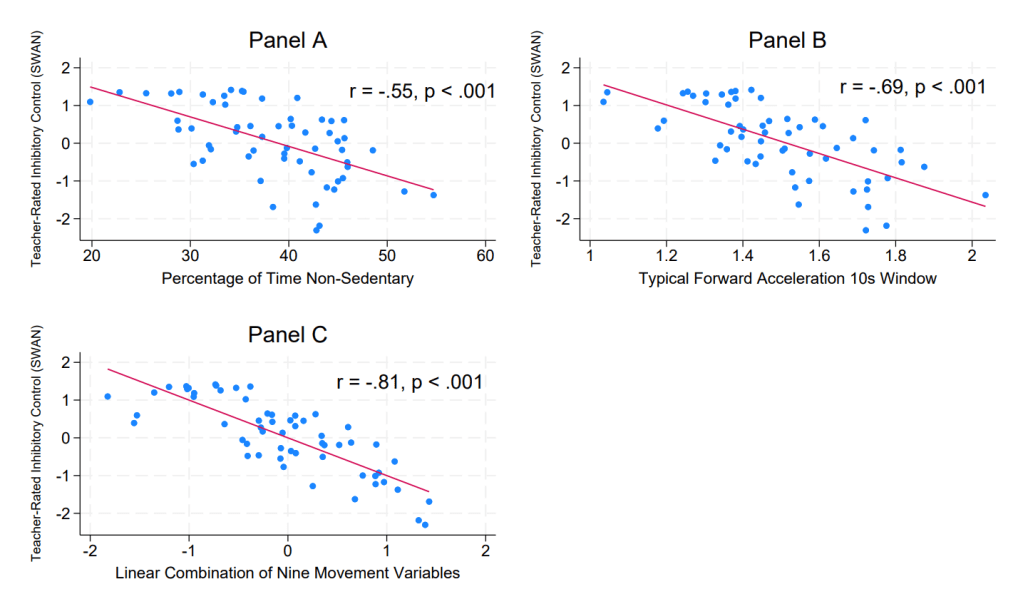
I am developing new ways of using wearable technology to observe children’s behavior naturalistically. My approach builds on a long tradition of measuring children’s self-regulation by observing the intensity, frequency, and duration of their behavioral responses. For young children, these responses are especially visible in their actions (i.e., movement), which wearable accelerometers can quantify precisely, objectively, and continuously.
My colleagues and I recently showed that preschool children’s typical intensity of forward acceleration during the school day was strongly related to teacher reports of their attention and inhibitory control (Koepp & Gershoff, 2024, Child Development; Koepp et al., 2022, Developmental Science). We applied machine learning methods ideally suited to the high-volume data to identify temporal patterns of children’s behavior.
Advancing Equity
I am starting a new project to examine how sensor-based methods can reduce researchers’ reliance on subjective reports that may contain bias. Such methods may help reduce disparities in behavioral ratings. More coming soon!
Links to Long-Term Outcomes
Self-control helps children ignore distractions and inhibit impulses that could disrupt their learning. The longer children can sustain self-control, the longer they may be able to take advantage of learning opportunities. My colleagues and I proposed that the temporal dynamics of children’s self-control can be observed via changes in their physical activity across the school day given the general expectation in schools for children to refrain from vigorous movement except during specific periods. Using accelerometers to continuously measure children’s behavior in their classrooms, we found that children who displayed larger increases in movement across the school day showed lower academic achievement in high school and lower educational attainment as adults (Koepp et al., under review).

Societies around the world aim to prepare children to be successful as adults–to complete their education, earning a comfortable living, stay healthy, and avoid criminal behavior. One highly influential study by Moffitt et al. (2011) found that the road to success began in childhood. Children who had less “self-control” (i.e., greater difficulty inhibiting impulsive behavior and controlling their attention) had greater financial struggles, poorer health, and a greater likelihood of criminality decades later (Moffitt et al., 2011). My colleagues and I recently completed a conceptual replication, documenting very similar findings in birth cohorts from the US and the UK (Koepp et al., 2023, Editor’s choice at Developmental Psychology).

Child Development in a Warming World
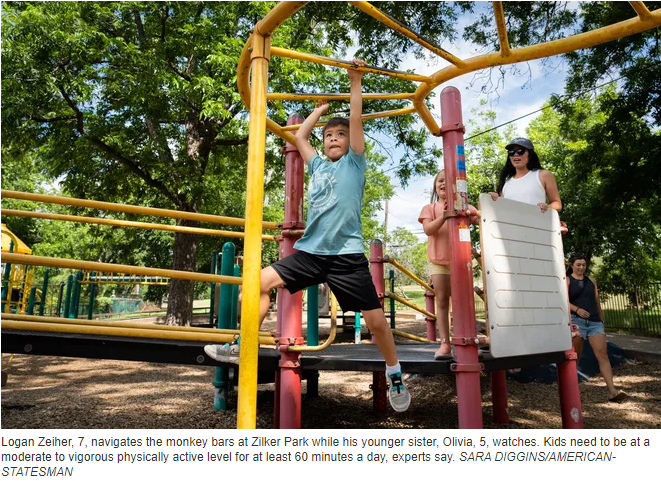
Young children engage in less physical activity on hot days (Koepp et al., 2023; JAMA Pediatrics). Because physical activity promotes a broad range of health outcomes in young children, schools may need to adapt the timing or structure of outdoor play to promote physical activity amid rising global temperatures.

Our work was featured in the Austin American-Statesman:
 Andrew E. Koepp